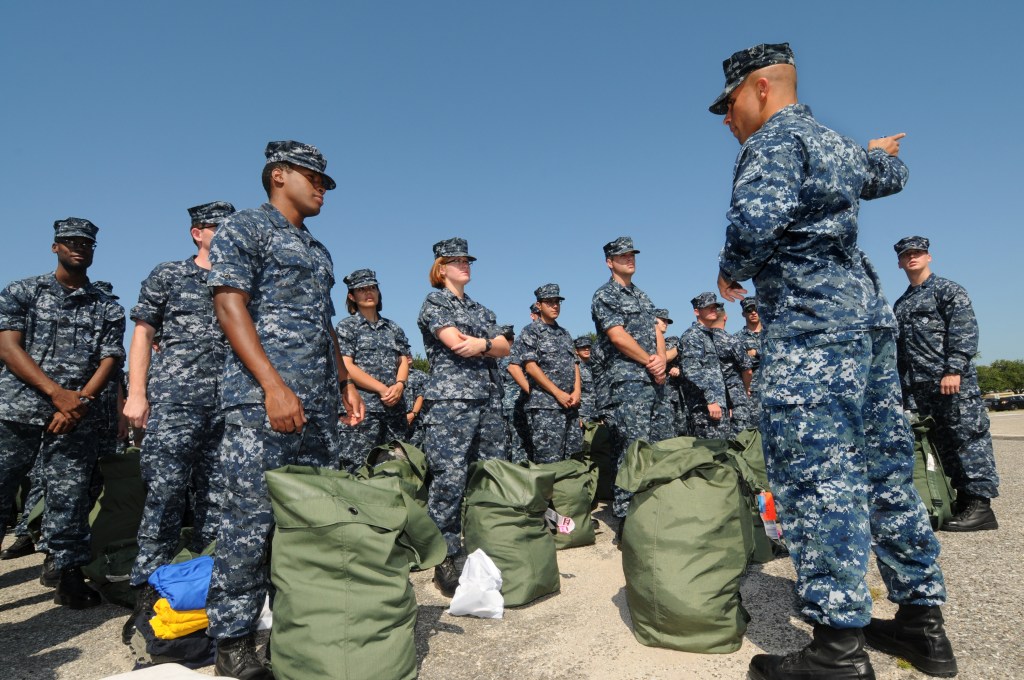
The Navy’s calculus for annual clothing maintenance allowances will change again this fiscal year as more of the service’s uniform changes begin to kick in.
It’s not free money, it’s extra pay that’s expected to be used to replace any worn-out uniform items.
Only enlisted sailors get clothing replacement allowances — by law, they’re expected to foot the bill for uniforms out of pocket — a Navy tradition dating back to 1775.
What a sailor gets is determined by a number of factors. Men and women wear the some of the same uniforms while there remains gender-specific versions of dress and service uniforms. Each have different costs.
New uniforms are also part of the equation this year. For example, everyone will see a drop in the required numbers of standard Navy Working Uniform blouses and pants from three to two.
The new lightweight versions of the uniform became available last year, and this year having one set is now a seabag requirement. Everyone will see an extra $39.52 in their payment to account for half of the cost of purchasing one full set of light NWUs.
PDF: 2017 Navy seabag for E-1 to E-6
But it’s unclear how many of the new blue NWUs will get purchased as next year’s seabag requirement is expected to show a change as the service starts issuing green NWU Type IIIs. Issue starts in boot camp this coming fall with availability in exchanges happening next January, allowing those in the fleet to begin purchasing greens of their own.
Sailors get two kinds of uniform allowances: basic and standard. Those with three years or fewer service get the basic allowance, because, officials say, they’ve just gotten their initial issue uniforms, which need at least three years to require full replacement.
PDF: 2017 Navy men’s seabag for E-7 to E-9
These allowances are paid annually in your end-of-the-month paycheck of your “anniversary month” — the month you entered boot camp.
The standard allowance for E-6 and below men is $500.40, $43.20 more than last year’s $457.20. This year’s basic allowance is $349.20.
For women of the same ranks, they’ll get $493.20, $55.20 more than the $468.00 they got last year.
PDF: 2017 Navy women’s seabag for E-7 to E-9
Women E-6 and below are beginning to get paid for their new “crackerjack” service dress blues, as their the old blue jacket, white shirt, dress pants, tab tie and “bucket” hat were deleted from the list.
Women can still wear their old SDBs and hat, however, as the new dress uniform and “Dixie cup” are not required until 2020.
But if they want, the Dixie Cup can be worn with the old jacket with their existing crackerjack service dress whites now. This year, they’ll get half of the cost of the new jumper and pants and neckerchief ensemble and will see the rest in next year’s payment.
Chiefs get a different standard allowance. For male chiefs, it’s a slight increase up to $649.46, $46.60 more than last year, mostly to pay for the new NWUs as well as a new poly/wool khaki shirt.
Female chiefs will see a drop of $16.43 this year receiving $653.17, down from last year’s $669.60, even though they’re now being paid for maintaining new khaki overblouses.
What sailors get each year factors in the cost and number of uniforms required by their expected wear life. The amount paid annually for each existing uniform item is a pro-rated cost spread over a uniform’s wear life.